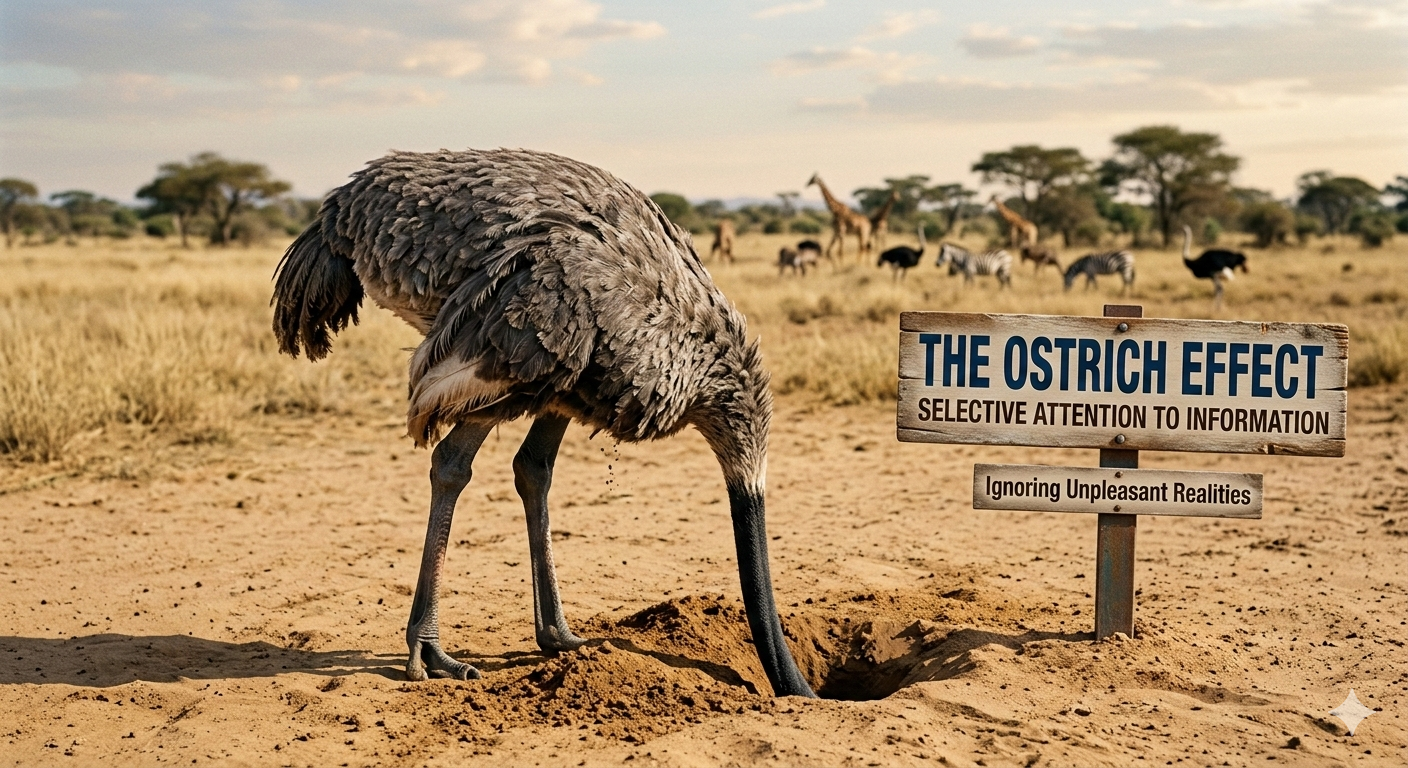
Imagine you’re a startup founder who just launched a new feature. You’ve been checking your analytics dashboard every hour for the last three days because the initial numbers looked promising. But then, a major competitor drops a similar update, and your daily active users start to dip. Suddenly, that dashboard feels like a haunted house. You find every reason not to log in. You tell yourself you’re “focusing on the long-term vision” or “giving the data time to normalize,” but the truth is simpler: you’re putting your head in the sand.
In psychology and behavioral economics, this is known as the Ostrich Effect. Coined by researchers Galai and Sade in 2003, it describes a pervasive human tendency to avoid exposing ourselves to information that we fear will cause us psychological discomfort. While the myth that ostriches actually bury their heads in sand is just that – a myth – the human version is very real and can be devastating for your career and your company.
The Psychology of Selective Attention
Why do we do this? According to a landmark study by Niklas Karlsson, George Loewenstein, and Duane Seppi, we don’t just treat information as a tool for making better decisions. Instead, we derive “hedonic utility” directly from our beliefs. In plain English: we like feeling right and feeling successful.
When we suspect news is bad, we treat the act of confirming that news as a cost. Our brains make a calculated (if often irrational) decision that knowing definitively that an outcome is negative is worse than merely suspecting it. By avoiding the data, we protect our “ego utility” in the short term, even if it degrades the quality of our decision-making in the long term.
The researchers identified three main pathways that drive this behavior:
- The Impact Effect: Definitive knowledge has a much larger psychological impact on our happiness than a vague suspicion. We’d rather live in the “maybe” than the “definitely” when things are going south.
- The Reference Point Updating Effect: When we pay close attention to news, our internal “benchmark” for success updates quickly. If we ignore bad news, we can maintain an outdated, more positive reference point for a little longer.
- The Risk Aversion Effect: We are naturally more sensitive to losses than gains. This creates an asymmetric preference: we actively monitor our “portfolios”, whether they are financial or professional, when the market is up, but we go dark when it’s down or flat.
Real-World Stakes: From Stock Markets to Startups
The study validated this effect by looking at how investors in Sweden and the U.S. check their accounts. The data was clear: investors log in significantly more often when markets are rising. When markets are flat or falling, they disappear.
But this isn’t just about stocks. For a working professionals, the Ostrich Effect shows up in every corner of work life. It’s the manager who ignores warning signs of a failing deal because they don’t want to perform the necessary due diligence. It’s the junior employee who avoids checking their performance review because they suspect it might be “ambiguous” or negative. It’s the parent who delays testing for a child struggling in school because they’d rather not have a formal diagnosis to worry about.
The paradox is that the more “risky” a situation feels, the more we pretend it doesn’t exist. This is especially dangerous for startup owners. In the early stages of a business, information is your most valuable asset. Delaying the realization that a product-market fit isn’t there doesn’t make the problem go away; it just ensures you’ll run out of runway before you can pivot.
Actionable Solutions: Pulling Your Head Out of the Sand
If you recognize yourself in these patterns, you’re not alone—it’s a deeply ingrained part of human nature. However, high-level performance requires fighting this instinct. Here is how you can build a culture and a mindset that embraces “definitive information,” even when it hurts.
1. Automate Your Bad News The Ostrich Effect relies on your discretionary choice to look at data. If you have to choose to log in to see a failure, you might not do it. Set up automated “red alerts” that push negative data to you via email or Slack. If the information is delivered automatically, you lose the ability to “bury your head”.
2. Lower the “Impact Effect” with Pre-Mortems The researchers found we avoid news because definitive knowledge has such a high psychological impact. You can lower this impact by conducting a “Pre-Mortem” before a project starts. Ask your team: “Assume this project has failed six months from now. What went wrong?” By visualizing the failure in advance, the definitive news becomes “expected,” which actually lowers the disutility of hearing it.
3. Separate Your Identity from the Data Much of the Ostrich Effect comes from wanting to maintain a positive self-image. If you view a drop in users as a personal failure, you’ll avoid the analytics. If you view the data as a “GPS signal” that simply tells you where to turn next, the emotional cost of looking at it drops significantly. Practice “motivated reasoning” for the search for truth, not just for the confirmation of your current beliefs.
4. The “Ambiguity Rule” The study found that we don’t just avoid bad news; we often avoid ambiguous news because we fear it might be bad. Make it a rule that “no news is bad news.” If you don’t have definitive data on a project’s status, assume the ostrich instinct is at work and force a “due diligence” check immediately.
The Bottom Line: Information is Utility
We have to stop thinking of information as something that only helps us make decisions. We must recognize that we derive real pleasure and pain from it. The “Ostrich Effect” is a short-term survival mechanism for our egos, but it is a long-term death sentence for our growth.
Whether you’re managing a multinational team or your own retirement portfolio, the most successful people are those who seek out definitive information specifically when things feel “adverse”. Don’t wait for the “rising market” to check your stats. Pull your head out of the sand, look at the “idiosyncratic” data of your life, and use the pain of bad news as the fuel for your next pivot.
Leave a Reply